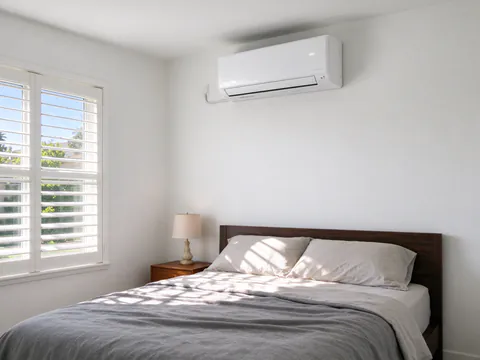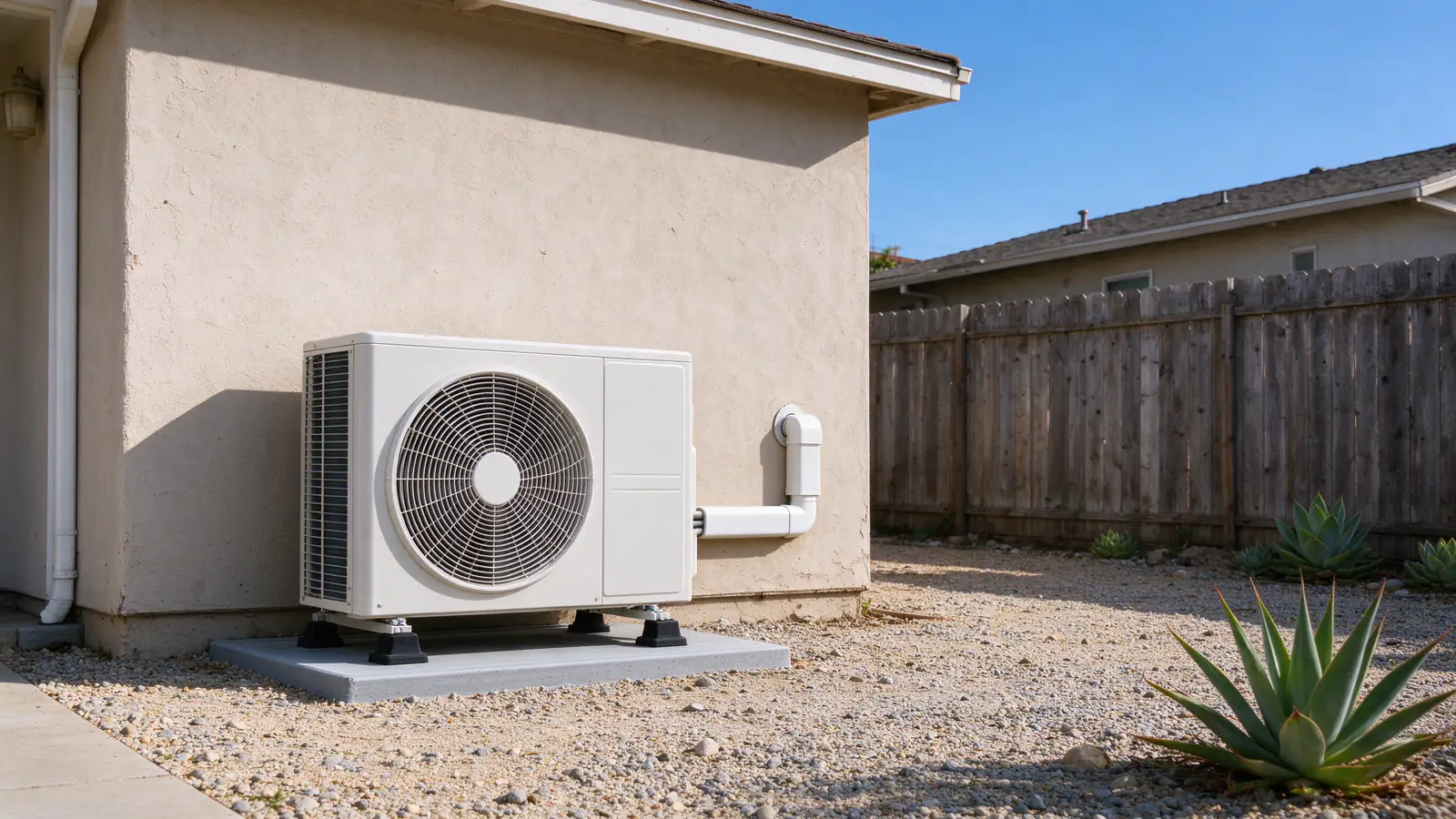
A well-installed inverter mini split has a low noise level: the indoor head at low fan speed is often the quietest cooling a room can have, and the outdoor unit is usually quieter than a conventional air conditioner because it slows down instead of cycling at full power. How loud it actually sounds depends on its published ratings, the distance to your ears or a neighbor’s window, and how it is mounted.
Mesa Mini Split San Diego installs mini splits across San Diego County, with the work done by licensed and insured contractors holding the California C-20 (HVAC) license, and noise is one of the factors in choosing where the outdoor unit goes. This guide explains where mini split sound comes from, how to read a decibel rating and what San Diego’s noise rules require.
Where the sound comes from
Indoors, most of what you hear is air: the blower pushing air across the coil and out through the louvers. It rises and falls with fan speed. Smaller sounds include the louver motor, plastic housings ticking as they warm or cool, refrigerant hissing or gurgling at start-up and, on heads with a pump, the condensate pump running for a few seconds when its reservoir fills.
Outdoors, the compressor and the condenser fan make most of the sound. An inverter compressor ramps its speed to the load, so it spends most hours well below full output and runs quieter than a single-speed unit that is either off or flat out. The loudest moments are a hot afternoon at full speed and, in heating mode, the defrost cycle, when a valve reverses the refrigerant flow with an audible whoosh.
How to read a decibel rating
Manufacturers publish a sound rating for each indoor head at each fan speed and for the outdoor unit in cooling and heating. A few points make those numbers useful.
The scale is logarithmic. A 10 dB increase is heard as roughly twice as loud; a 3 dB increase doubles the sound energy but is only just noticeable. A head rated a few decibels quieter than another will not sound dramatically different.
Measurement method matters. A sound pressure rating in dB(A) is measured at a stated distance from the unit, often about a meter, under lab conditions. A sound power rating describes the total sound the unit emits and is always a larger number. Compare like with like, at the same fan speed or operating mode.
Distance and surroundings change it. In open air, sound from a small source drops by about 6 dB each time the distance doubles. In a narrow side yard, walls and fences reflect it back, so the drop is smaller. A unit tucked into a corner between two walls sounds louder than the same unit on an open pad.
San Diego’s noise limits
The City of San Diego’s noise ordinance sets one-hour average sound level limits at or beyond the property line. For single-family residential zones they are 50 dB from 7 a.m. to 7 p.m., 45 dB from 7 to 10 p.m. and 40 dB from 10 p.m. to 7 a.m. Multifamily zones (up to one unit per 2,000 square feet) allow 55, 50 and 45 dB. The night limit is the one that shapes outdoor unit placement, because a mini split cooling a bedroom often runs all night in late summer.
The same limits connect to the City’s setback rule: an air conditioner unit in a required side or rear yard sits 4 feet from the property line, unless sound attenuation features are incorporated and shown to comply with the noise limits. The placement guide covers that rule and the Coastal Overlay Zone’s view corridors.
SB 222’s inverter heat pump provision
SB 222, enacted as Chapter 738 of the Statutes of 2026, limits the local standards a city or county may apply to residential heat pump HVAC installations from January 1, 2027. On noise, it allows noise standards for inverter-based heat pumps “not to be less than 15 decibels higher than any statutory maximum regulating decibel limits for noninverter-based technologies.” The City of San Diego has not yet published how it will apply this provision or the law’s 3-foot side-yard setback cap. Until it does, placement is planned to the current limits, and the rules are confirmed per address with the permit.
Inverter quiet modes
Most mini splits offer a quiet, night or silent mode that caps the indoor fan speed, and many outdoor units offer a low-noise setting that limits compressor and fan speed during set hours. These modes trade capacity for quiet. They suit a coastal bedroom on a mild night; on an inland heat-wave night in El Cajon, a capped unit may not keep up. Correct sizing helps here: a unit sized to the room’s real load spends more time at low, quiet speeds than an undersized one running flat out.
Vibration: when a quiet unit sounds loud
A unit can be quiet on paper and still hum through the house, because vibration travels through solid paths. An outdoor unit bolted to a bracket on a wall can drive the wall like a speaker, especially a hollow-framed wall behind a bedroom. Rubber isolation feet or pads under the unit break that path. Line sets clipped tight against framing, or touching each other inside a wall, carry compressor vibration indoors; a gap or a soft clamp stops it. A pad that is not level can let the unit rock slightly and buzz. These are installation details, and they matter as much as the equipment’s rating.
When a noise means something is wrong
New or changing sounds are worth noting: rattling panels, a fan blade striking ice or debris, a grinding motor bearing, a loud buzz from the outdoor unit or a compressor that clatters at start-up. The sound alone does not prove the cause; a loose panel and a failing component can sound alike. A mini split repair visit diagnoses it before anything is replaced, and maintenance keeps blowers and coils clean, which also keeps them quieter.
Comparing noise before you buy
When comparing equipment, line up the indoor rating at the fan speed you will actually use and the outdoor rating in the mode the house needs most, then ask where the outdoor unit will sit and how far that is from the property line and the nearest bedroom window. Window units are a useful benchmark; the mini split vs window unit guide compares them. For a placement planned around noise, call or request an estimate; the single-zone installation page shows how a one-room job runs.