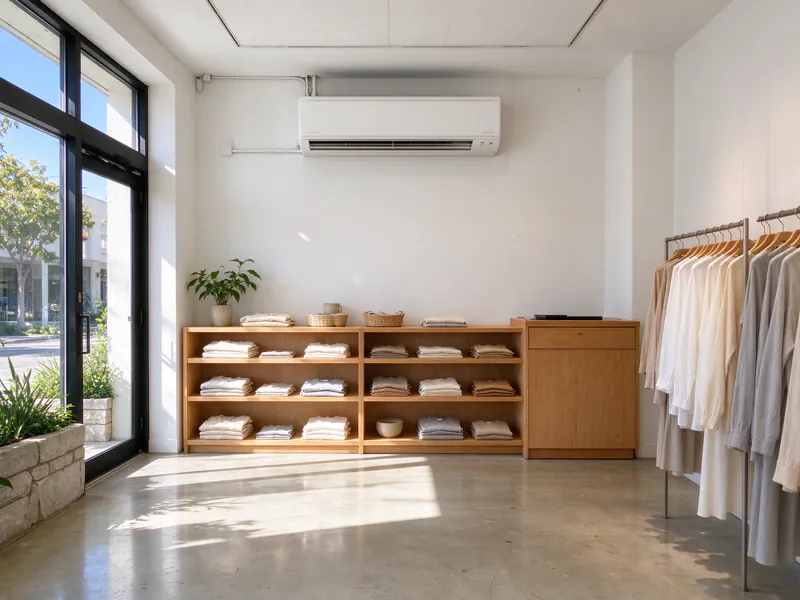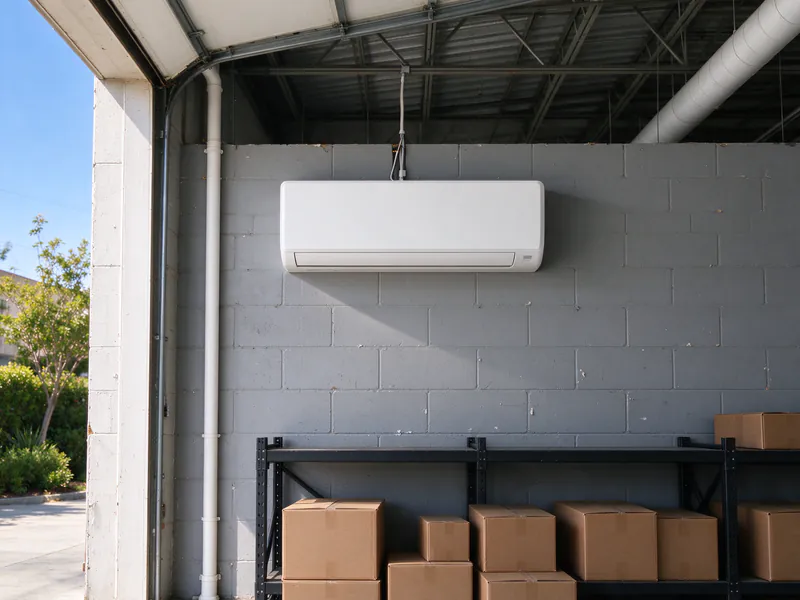
Mesa Mini Split San Diego installs light commercial mini splits across San Diego County: small offices, retail shops, restaurant dining rooms, shop offices inside small warehouses and the common areas of multifamily buildings. The work is done by licensed and insured contractors holding the California C-20 (HVAC) license, with the same load-first approach used on homes, adjusted for how businesses use their space.
Light commercial is where ductless equipment is at its most practical. A storefront without ducts, an office carved out of a warehouse, a dining room added in a former retail space: each has a load that a few well-placed heads can carry, and each needs rooms controlled separately. The boundaries are just as clear. VRF systems serving whole buildings and large central plants are a different class of equipment and are outside this service.
How a commercial load differs from a home
A commercial load is built from what happens in the space, not from its floor area. People, computers, lighting, display cases and door traffic all add heat, and in many small businesses they outweigh the heat coming through the walls. That is why the contractor asks about occupancy and equipment before measuring windows.
San Diego’s climate splits the problem by location. The California Energy Commission’s design data puts the 1% cooling design temperature at 82°F at Lindbergh Field and 90°F in El Cajon, and NOAA’s normals count about 3 days a year at 90°F or above at Lindbergh against 56.8 in El Cajon. A shop with west-facing display glass in El Cajon has a very different afternoon from an office in a downtown building near the bay. The sizing guide explains how loads are built, and the El Cajon service area page covers the inland side.
Occupancy schedules and after-hours loads
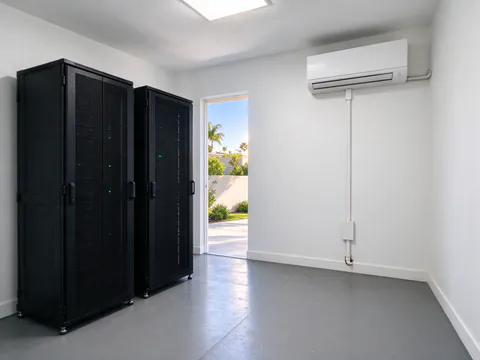
Most homes need conditioning in the evening; most offices need it from morning to late afternoon on weekdays and almost not at all on weekends. Restaurants peak at lunch and dinner. A schedule that swings from empty to full favors inverter equipment that can run at low output most of the time and ramp up when the room fills, and it is one reason a multi-zone system or several single-zone systems suit offices where rooms fill at different times, and it favors controls that set back automatically when the space closes. Some loads never close: a network closet, a refrigerated display or a small lab keeps making heat overnight. Those loads need their own head on their own control, so the rest of the space can set back. A dedicated equipment room is its own design, covered on the server room mini split page.
Choosing heads for business spaces
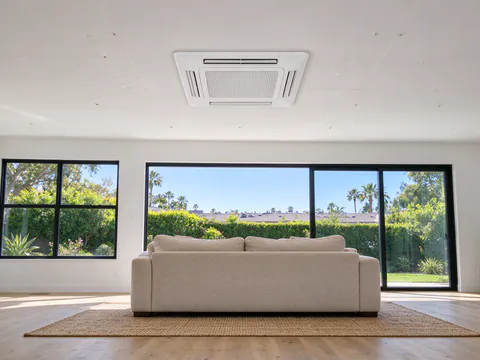
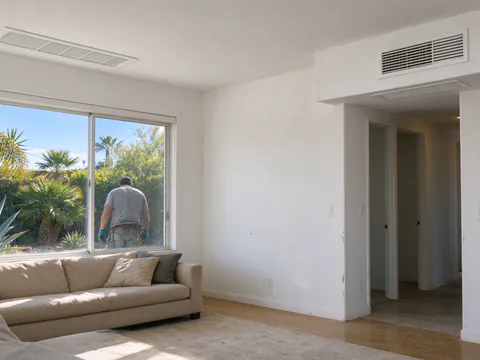
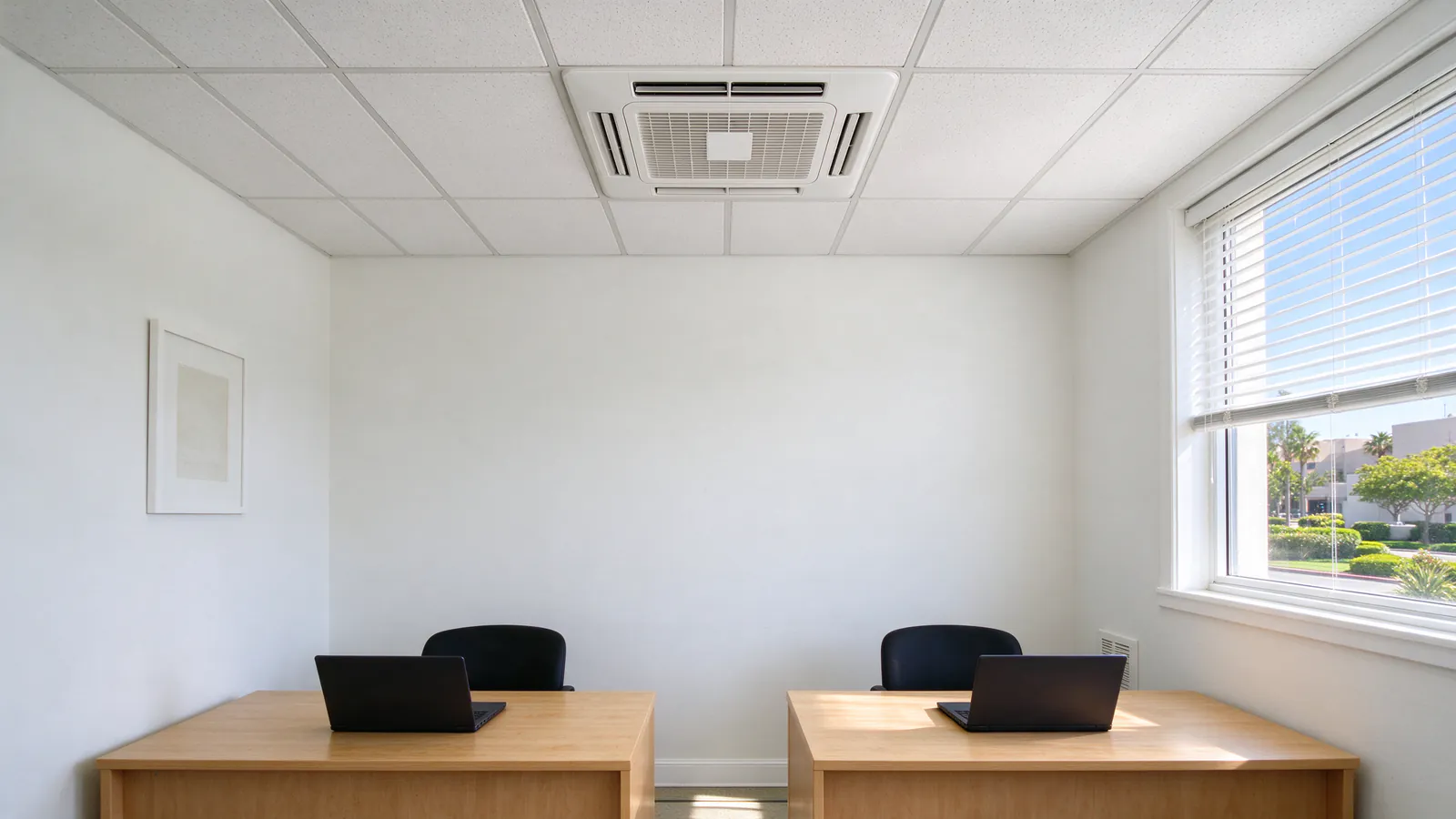
Head style follows the ceiling and the use. In offices and shops with suspended ceilings, a ceiling cassette sits flush in the grid and throws air four ways, which suits open rooms with desks or racks spread across them. Where the ceiling is drywall with space above, a concealed duct unit can feed two or three small rooms through short ducts and leave only grilles in sight. Wall heads remain the simplest and least expensive choice for a back office or break room. The indoor unit types guide compares them.
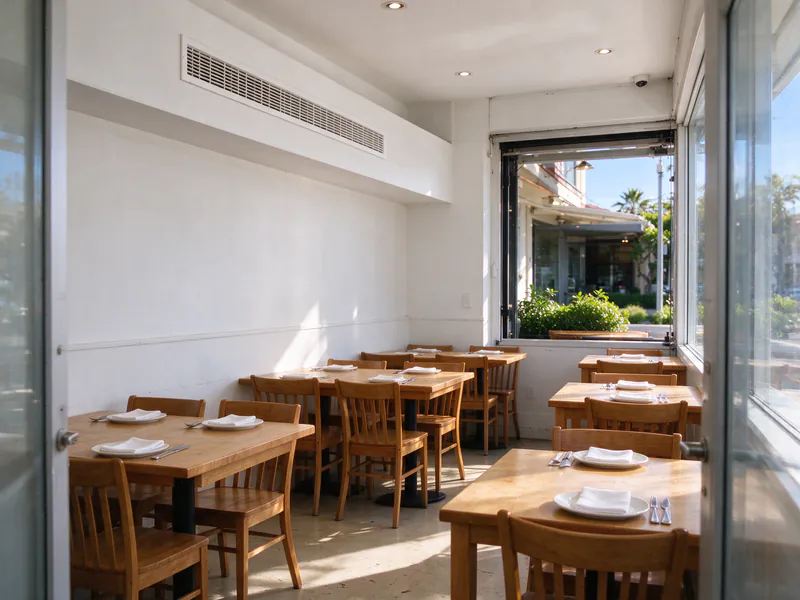
In a restaurant, heads go in the dining room and away from the cooking line, where grease in the air would coat the coil and filters quickly. Mini splits cool dining rooms well; the heat and ventilation of a working commercial kitchen are a separate design and not part of this service.
Permits for commercial work in the City of San Diego
A new mini split in a nonresidential building needs plans and plan review in the City of San Diego. The fee schedule in Development Services’ Information Bulletin 103 lists the same per-unit mechanical fees as for homes, $176.57 for the first mini-split air handler and $52.39 for each additional one, with $131.52 listed for each HVAC condensing unit. The difference is the path: new nonresidential mechanical work does not qualify for the simple no-plan permit, so the plans go through review, which the City bills at an hourly rate of $176.84 under Information Bulletin 501. The number of review hours is not published, so the permit total is only known once the City sets it.
More pieces can apply. Adding circuits in a nonresidential building needs a separate electrical permit; the first five circuits are listed at $176.57. New framing, drywall or finishes bring a separate building permit. Where the mini split is part of a larger interior improvement, the City charges the mechanical portion by floor area, $176.57 per 5,000 square feet. Replacing a nonresidential mini split in kind does qualify for the simpler permit. The permit and inspections are part of the work. Other cities in the county issue their own permits, and their requirements are confirmed per address; the permit guide covers residential rules in more detail.
Roof, wall or ground for the outdoor units
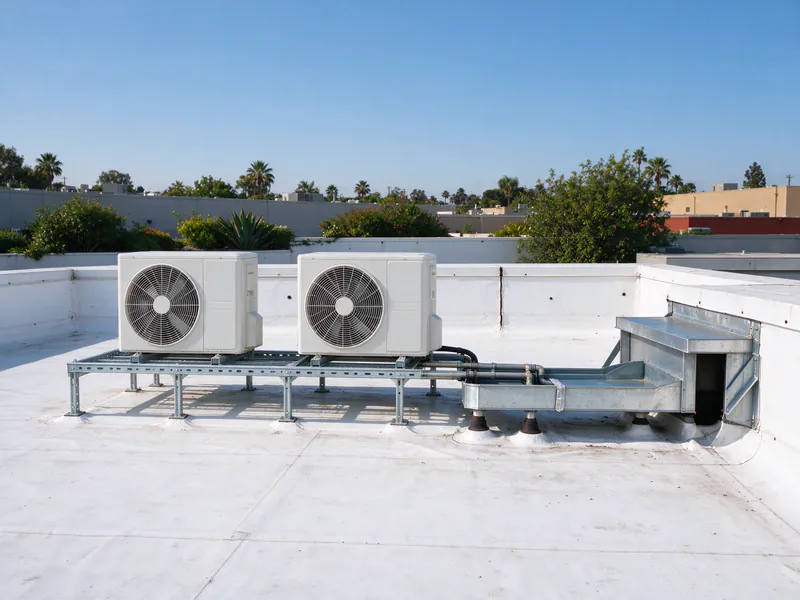
Outdoor units go where they can breathe, be serviced and meet the rules. A ground pad in a rear service area is the simplest when there is room. A wall bracket saves floor space. A roof keeps units away from customers and parking, but it brings structure, roof penetrations, flashing and a safe way up for every future service call. The City of San Diego requires plans and a building permit when the supporting structure has to be altered for equipment, and structural calculations when equipment weighs more than 400 lb or its center of gravity sits more than 4 ft above its base.
Noise matters at the property line. The City’s noise ordinance sets one-hour average limits by zone: 65 dB by day and 60 dB at night at commercial properties, and 55, 50 and 45 dB for day, evening and night at lower-density multifamily properties. Outdoor units serving a multifamily common area, or a shop that backs onto homes, are placed with the nearest residential limit in mind. The placement guide covers clearances and siting.
Power, access and the work schedule
Commercial buildings often carry three-phase service, and some larger mini split outdoor units are made for it, while others run on single-phase power. The electrical review settles which equipment fits the service, how many circuits are added, where disconnects go and whether the panel has room. The electrical requirements guide explains the parts.
Access shapes the job as much as the equipment. A retail space may need installation work outside business hours; an office may need ceiling tiles moved over occupied desks; a multifamily lobby needs a path for equipment that does not block residents. These conditions belong in the written scope because they change how the work is staged.
Condensate in commercial spaces
Every head makes water in cooling, and in commercial spaces the drain often has the longest route. A cassette in the middle of an office ceiling may be far from any exterior wall, so it uses a pump and a drain line run above the ceiling to a suitable outlet. A wall head in a shop can usually drain by gravity. A drain that leaks above a suspended ceiling stains tiles and can drip onto stock, desks or customers, so the route, the pump and any overflow safety switch are named for each head. The condensate drainage guide covers both methods.
What moves the cost of a commercial install
There is no reliable published price for light commercial mini split installation, so cost is set by scope. What moves it: the cooling load and number of heads, head style (cassettes and concealed duct units cost more than wall heads), the outdoor unit location and any roof or structural work, electrical service and circuits, single-phase or three-phase equipment, plans and plan review time, condensate routes and pumps, ceiling access, after-hours work, and ventilation work if the space needs it.
Labor is one documented local factor. The Bureau of Labor Statistics puts the mean wage for electricians in the San Diego-Chula Vista-Carlsbad metro at $39.54 an hour against a national mean of $34.37. A wage is not a billing rate: the billed rate also carries insurance, licensing, vehicles and overhead. Once a system is running, mini split maintenance keeps filters and drains clear, which matters more in dusty shops and busy dining rooms than in most homes.