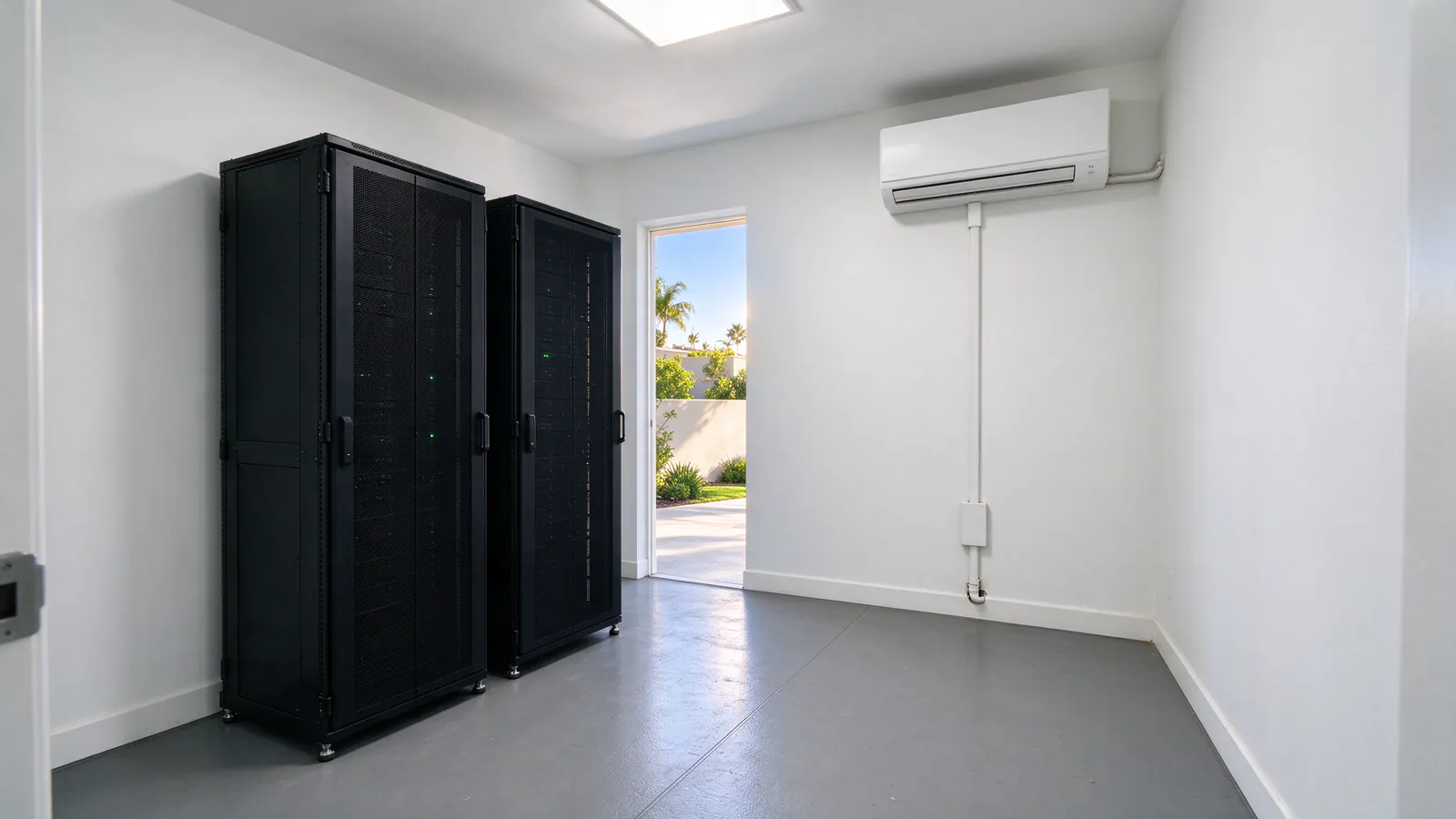
Mesa Mini Split San Diego installs mini splits for server rooms, IT closets and network rooms across San Diego County, as part of its commercial mini split installation work. The installation is done by licensed and insured contractors holding the California C-20 (HVAC) license. A server room is a different cooling problem from an office: the heat never stops, the room needs cooling on cold nights, and a failure is a business problem within hours.
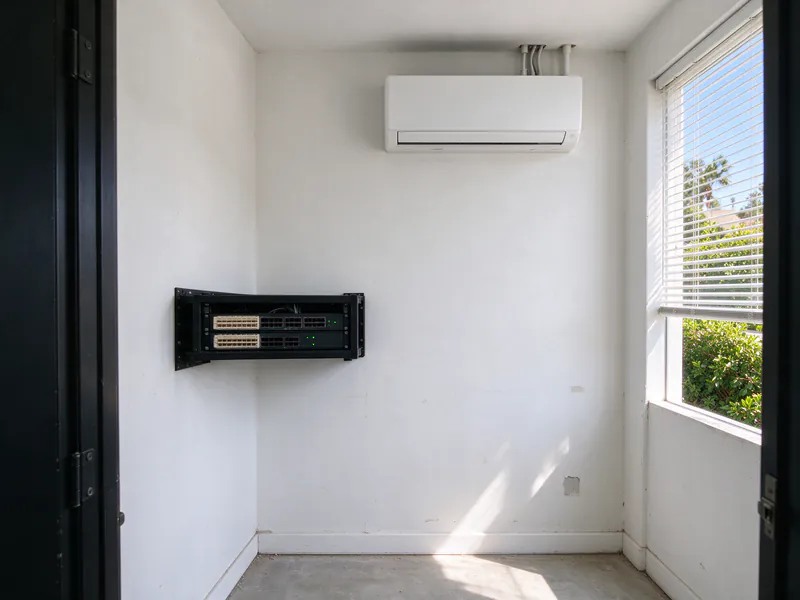
The common starting point is a closet or small room that was never meant to hold equipment. A few switches became a rack, the rack gained a server and storage, and the office air conditioning that sets back at 6 p.m. stopped being enough. A dedicated mini split fixes the schedule problem because it runs on its own control, around the clock, regardless of what the rest of the building does.
Sizing from the equipment’s heat
A server room load is almost all sensible heat from electronics, and it is sized from power, not floor area. Nearly every watt the equipment draws becomes heat in the room, and one kilowatt equals about 3,412 BTU per hour. A rack drawing 3 kW therefore adds about 10,200 BTU per hour before lighting, people and heat through walls and ceiling are counted. The most reliable number comes from the equipment’s measured draw, from a smart power strip or UPS display, rather than adding up nameplate ratings, which usually overstate it.
Growth belongs in the design. Equipment rooms tend to gain hardware, and a unit sized exactly for today’s load leaves no margin. The other direction is a risk too: a unit far too large for a light load cycles on and off, which is hard on the compressor and lets the room temperature swing. Inverter equipment that modulates down helps, but its minimum output still has to sit below the room’s real load. The sizing guide covers how loads are built for homes; the logic carries over with the equipment load added.
Cooling all year, including on cold nights
A server room in San Diego needs cooling in January as well as August. Most of the time that is easy: NOAA’s climate normals put the average December-to-February low at San Diego’s Lindbergh Field at 50.6°F, with no nights at or below freezing. Inland, conditions are colder. NOAA counts about 2.5 nights a year at or below 32°F in El Cajon and 40.2 at Ramona, so an equipment room in El Cajon or Escondido needs the low-ambient question answered more carefully than one near the coast.
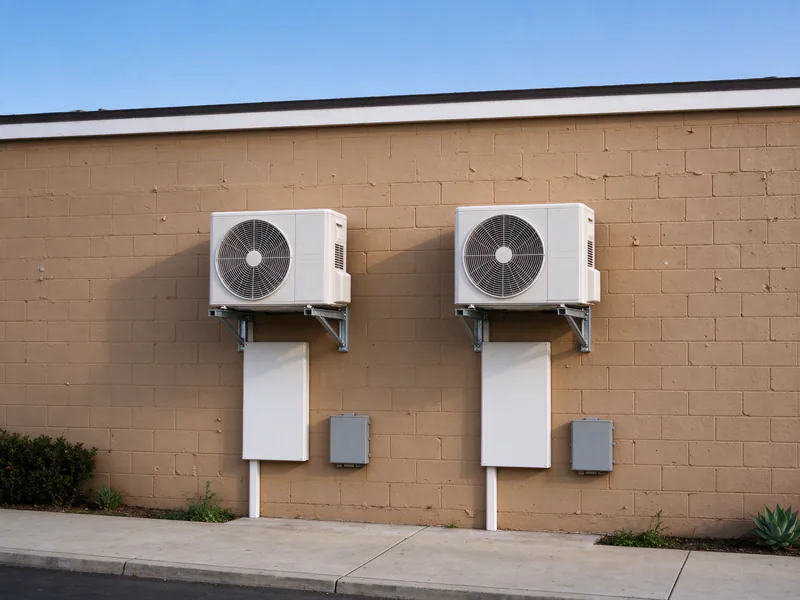
Standard mini splits are designed around comfort cooling, and many limit or stop cooling below a certain outdoor temperature, because people do not need cooling on cold nights. A server room does. The answer is equipment rated for low-ambient cooling, or a low-ambient kit where the manufacturer offers one, which keeps head pressure stable so the compressor can keep running when it is cold outside. The temperature rating is model specific and is read from the spec sheet, never assumed. Outdoor unit placement matters here too: a unit on a windy, exposed roof sees colder conditions than one sheltered against a wall. The placement guide covers siting.
Dehumidification balance
Mini splits remove moisture whenever they cool, and comfort models are designed to remove a fair amount, because people care about humidity. A server room has almost no moisture load of its own, so a unit running continuously can dry the room more than the equipment needs. The goal is a stable room, neither damp nor bone dry. The moisture that does arrive comes in with outside air through doors and gaps, and late-summer coastal air carries plenty: NOAA’s normals put the August mean dew point at Lindbergh at 62.5°F. Equipment is selected with its sensible capacity in mind, and the setpoint is chosen with the IT equipment’s own operating range, rather than set as cold as the unit allows.
Redundancy: planning for a failed unit
Every mechanical system fails eventually, so the useful question is what happens when this one does. With a single unit, the room heats until a repair is made, and in a small closet that can be quick. Redundancy means a second unit able to carry the room on its own, often described as N+1: the units needed for the load, plus one.
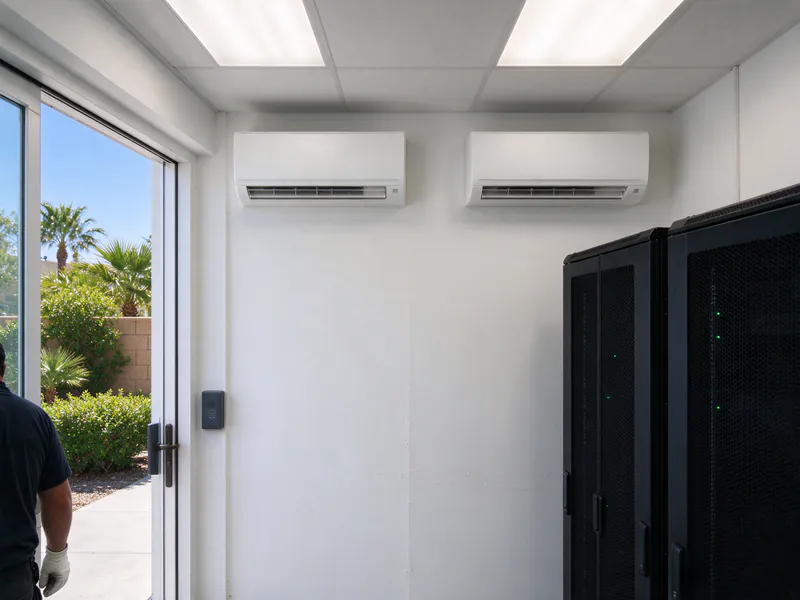
Two common patterns follow. In the first, two units alternate, one leading and one standing by, switched on a schedule so wear is shared and the standby unit is proven to work. In the second, both units run, and either can carry the whole load if the other fails. Both need a controller or controls that switch units automatically, and both double the condensate routes, circuits and outdoor units to plan. Where a short outage is tolerable, a single unit with a temperature alarm and a plan for emergency mini split repair may be the honest choice, and the written scope says so.
Condensate: keep water away from the racks
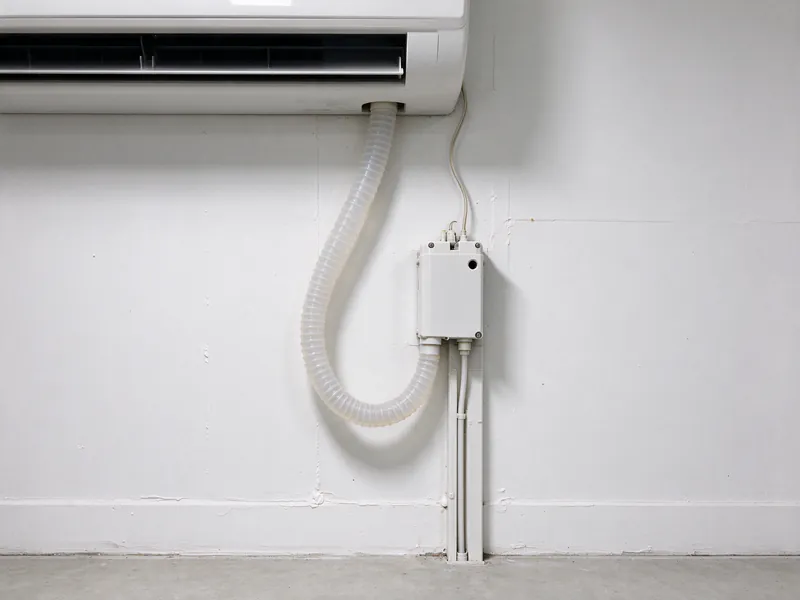
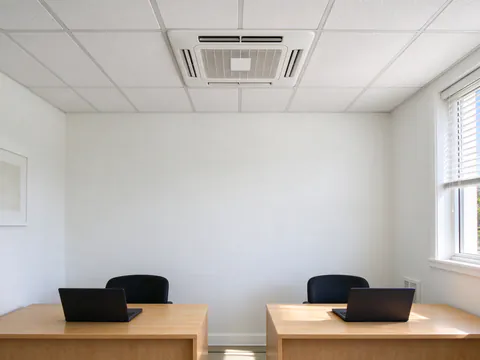
Every head makes water in cooling, and in an equipment room that water has to go somewhere safe. The rule is simple: the head and its drain do not sit over the equipment. The head goes on a wall where its throw reaches the racks but its drain line runs away from them. Where gravity can carry water to an outside wall, it does. A ceiling cassette is rarely the right head here, because it hangs over the room’s middle and its built-in pump discharges overhead. Where it cannot, as in an interior room, a condensate pump lifts it, and the pump carries an overflow safety switch wired to stop the head before water spills. A failed pump that shuts down the cooling is a problem; a failed pump that drips onto a switch is a worse one. The condensate drainage guide covers both drain types.
Monitoring and alarms
A server room unit should not fail silently. Many mini splits can report faults through dry contacts or a control interface, and many IT rooms already have a temperature sensor feeding the network monitoring system. The design connects the two where the equipment allows it, so a high room temperature or a unit fault sends an alert to whoever manages the equipment. Exactly what can be connected depends on the model and on the monitoring system, so it is agreed with the IT side during design.
Power, disconnects and permits
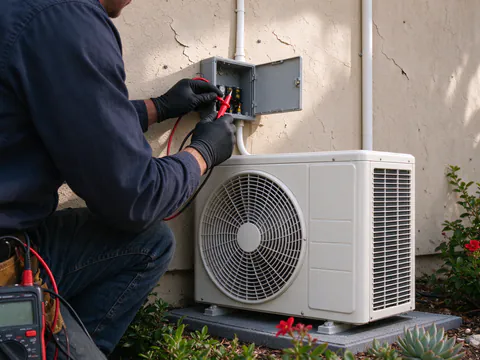
Each outdoor unit needs a dedicated circuit sized from its nameplate and a disconnect within reach. In a redundant design, each unit gets its own circuit so one tripped breaker does not take out both. Commercial buildings may supply single-phase or three-phase power, which narrows the equipment that fits. The electrical requirements guide explains the parts.
In the City of San Diego, a new mini split in a nonresidential building is submitted with plans and goes through plan review, billed by the hour, plus a separate electrical permit when circuits are added. The permit guide explains the residential side. The per-unit mechanical fee in the City’s Information Bulletin 103 starts at $176.57 for the first mini-split air handler and $52.39 for each additional one. The permit and inspections are part of the work.
What moves the cost
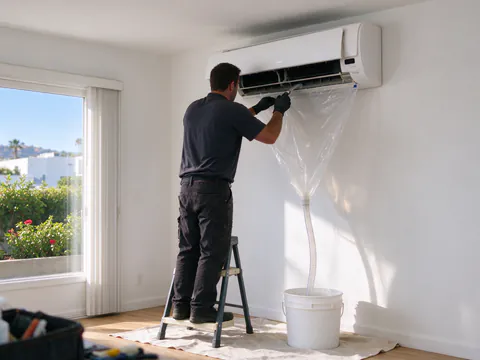
There is no reliable published installed price for server room mini splits, so cost follows the scope: the equipment heat load, continuous-duty and low-ambient ratings, a second unit and its controller for redundancy, the condensate pump and overflow switch, monitoring connections, dedicated circuits, the outdoor unit location and access, and plans and plan review time. Once installed, filters and drains in a unit that never stops need regular attention; mini split maintenance covers both, and an equipment room is a good case for checking the standby unit at the same visit.