
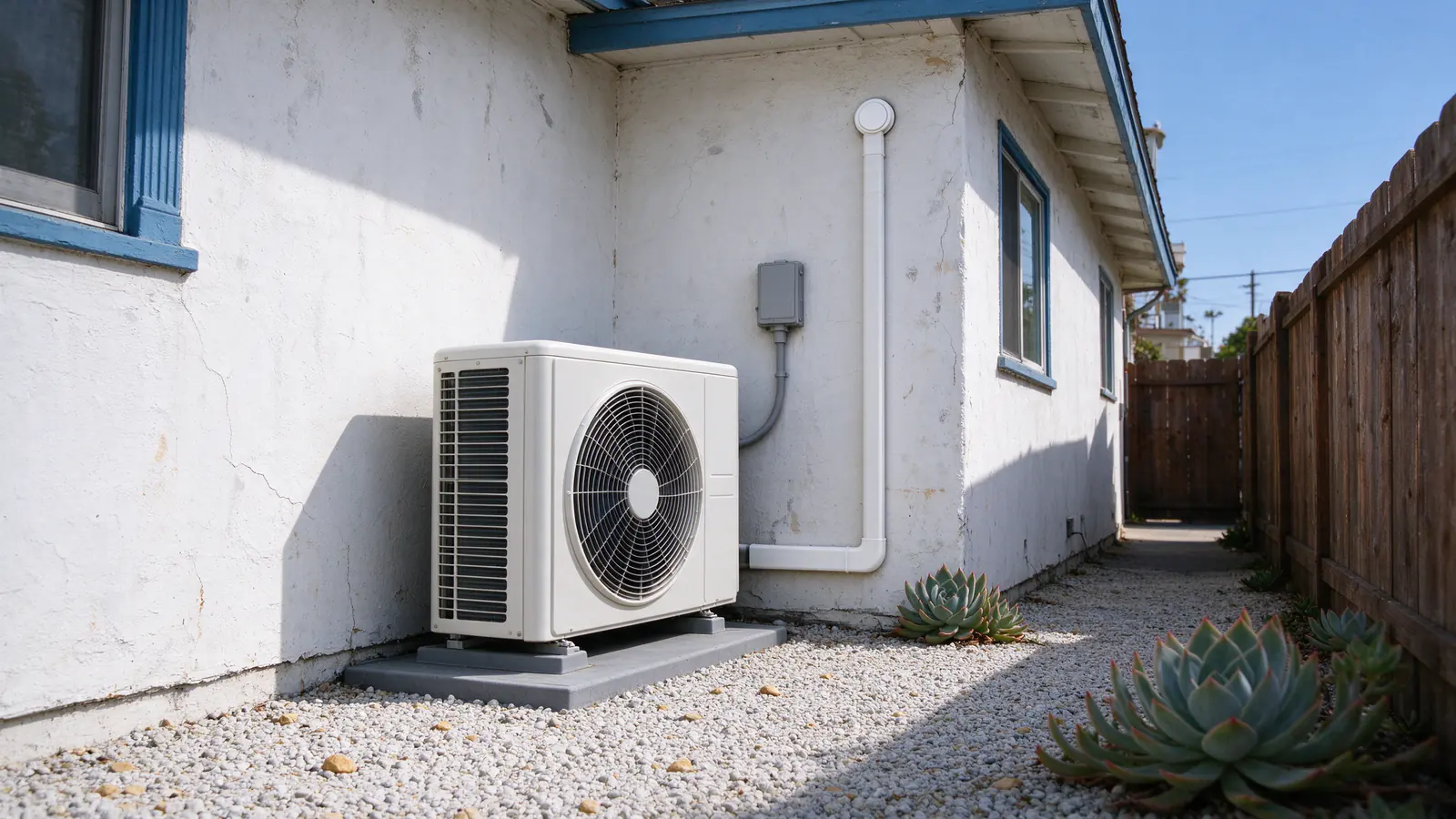
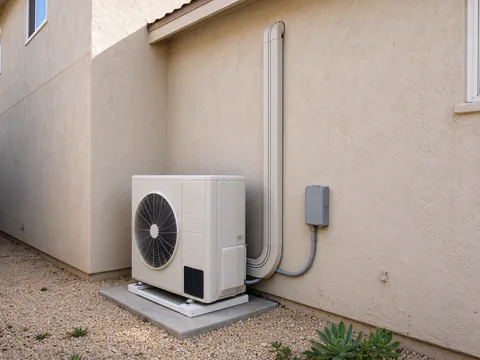
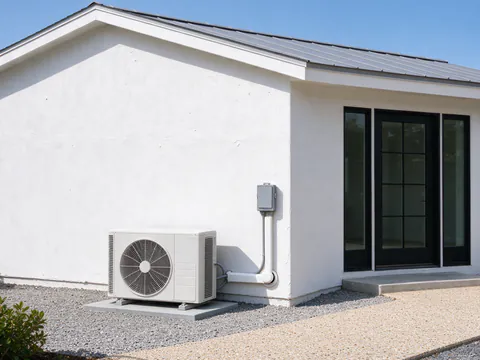
On a coastal San Diego lot, the first question in a mini split installation is rarely which brand or how many tons. It is where the outdoor unit is allowed to sit. Side yards in Ocean Beach and Pacific Beach can be only a few feet wide, the City’s code limits what goes into them, and parts of the coast add Coastal Overlay rules on top. Settle that spot and most of the design follows: the line-set length, the head location, the drain route and the coil protection the outdoor unit needs.
Mesa Mini Split San Diego installs mini splits in Point Loma, Ocean Beach, Mission Beach, Pacific Beach and La Jolla, through licensed and insured contractors who hold the California C-20 (HVAC) license. These neighborhoods sit in the City of San Diego, so permits go through the City’s Development Services Department, power is delivered by SDG&E, and generation comes from San Diego Community Power unless a household has opted out.
Where the outdoor unit can go
City of San Diego code lets an air conditioner sit in a required side or rear yard of a residential zone when the unit is at least 4 ft from the property line. Closer is allowed only where sound attenuation is built in and shown to meet the City’s noise limits, which for single-family homes are 50 dB by day and 40 dB at night at the property line. On a narrow lot that turns the outdoor unit’s rated sound level into a real selection factor.
Two coastal rules sit on top. In required yards within view corridors designated in the Coastal Overlay Zone, that equipment encroachment is not allowed at all. And state law is about to move the side-yard number: SB 222 says that from January 1, 2027, cities may impose setbacks of no more than 3 ft in side and back yards and 10 ft in front yards for residential heat pump systems. How the City will apply that to its 4 ft rule has not been published, so placement is confirmed per address. A heat pump mini split, which heats as well as cools, is the kind of system the new law covers. The placement guide covers clearances and airflow, and the permit guide covers the City’s rules.
Salt air and the outdoor coil
Onshore wind carries salt that corrodes the thin aluminum fins of an outdoor coil. At least one major manufacturer’s installation manual tells installers to choose a spot where the unit is not directly exposed to salt, because it may shorten the unit’s life. In practice that means the lee side of the house, out of the direct wind off the water, when the setback rules allow it. Factory coil coatings help: one manufacturer rates its coastal fin coating at 2,000 hours under the ASTM B117 salt-spray test. No manufacturer document sets a distance-from-the-ocean rule for San Diego, so the useful questions are about exposure: does the spot face the water, take spray or sit on a bayfront? A coastal quote should name the coil protection of the exact model, and mini split maintenance should include rinsing the coil.
Small loads, damp air
The coast’s problem is rarely heat. The California Energy Commission’s design data puts Lindbergh Field’s 1% cooling design temperature at 82°F, with a 42 to 44°F heating design, and NOAA’s normals count about 3 days a year at 90°F or above. That is why coastal houses were often built without central air conditioning. What makes rooms uncomfortable is moisture and trapped heat: Lindbergh’s mean dew point climbs to 62.5°F in August, and during the September 2024 heat event the overnight low there stayed at 75°F on September 8, removing the cool-down that open windows rely on.
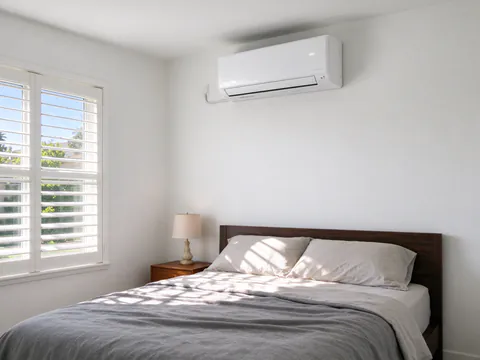
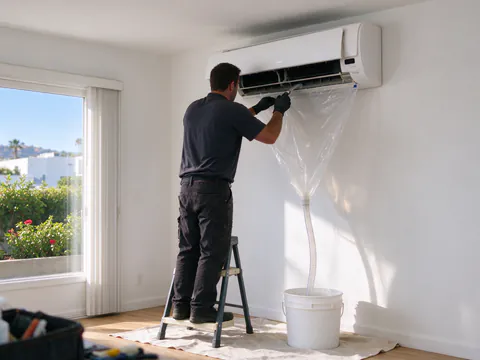
That combination punishes oversizing. A unit that is too big for a small coastal bedroom reaches the setpoint quickly, stops, and leaves the air clammy. A Manual J load calculation, an inverter whose minimum output sits below the room’s usual load, and a dry mode for muggy days matter more here than capacity. Condensate matters too: a coastal head makes water steadily through late summer, so the drain route is planned with the same care as the line set. The coastal vs inland guide compares this with East County, where the El Cajon page shows the opposite problem.
Point Loma, the beaches and La Jolla
Point Loma and Ocean Beach hold some of the oldest housing on the coast. Census figures for ZIP 92106 show 78.8% of homes built before 1980 and 30.2% before 1950, and 92107 is close behind at 77.6% before 1980. In houses of that age along Rosecrans Street, through Loma Portal and Roseville or out toward Sunset Cliffs Boulevard, a house without ductwork can add cooling through a ductless head without opening ceilings. The City’s permit records show how often that is the choice: from October 2025 to September 2026, mini splits appeared in 15 of Ocean Beach’s 31 HVAC approvals, 48%, and in 30 approvals in the Peninsula planning area. Lots near Sunset Cliffs and the bluffs are where the coastal permit exemption needs checking first.
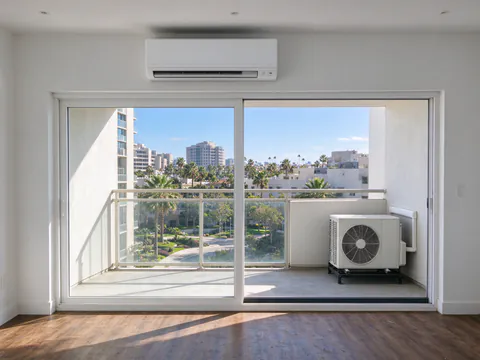
Pacific Beach and Mission Beach are denser. In ZIP 92109 only 27.4% of homes are single-family detached, so condos and small multi-unit buildings off Garnet Avenue and Mission Boulevard are common, and 9.9% of households report using no heating fuel at all. For an owner in a building with an association, a new state law, AB 1684, takes effect on January 1, 2027 and bars an HOA from prohibiting a code-compliant cooling system, heat pumps included, in the owner’s separate interest, while still letting it require a licensed contractor and repair of any common-area damage. The condo installation page explains how that works in practice.
La Jolla, reached along La Jolla Boulevard through Bird Rock or down Torrey Pines Road toward La Jolla Shores, recorded 33 mini split approvals in the same City data, and 65.6% of homes in ZIP 92037 were built before 1980. Where a larger house needs several rooms conditioned, multi-zone systems come into play, and bluff-top and beach-adjacent lots are again where the coastal permit question comes first. Coastal ADUs carry their own coastal permit step, covered on the ADU page.
How a coastal San Diego job usually runs
It starts with a call about the room or rooms and the address. The address comes first because it answers the screening questions: whether the lot sits in a Coastal Overlay view corridor, on a bluff edge or beach, or on a historically designated property, any of which changes the permit path. The site visit then measures the rooms and runs the Manual J calculation, checks the side and rear yards against the setback and noise rules, picks the most sheltered legal spot for the outdoor unit, and maps the line set, drain and circuit back to the panel.
A written, itemized scope names the equipment, its coil protection, the route, the line-hide and any panel work. For a house or duplex, the City issues a no-plan combination permit, with the fee starting from $176.57 for the first mini split. Installation ends with a nitrogen pressure test, evacuation checked with a micron gauge, charge to the manufacturer’s specification, a run in cooling and heating, and a walkthrough of the controls, filters and drain. The cost estimator gives a budgeting range before any visit.