
Oceanside’s municipal airport averages about eight nights a year at or below freezing, while Lindbergh Field in San Diego averages none. That one difference changes what a mini split installation on the North County coast is for: summer cooling is the easy part, and winter heat carries more weight than it does in San Diego’s beach neighborhoods.
Three cities share this stretch of North County: Oceanside, Carlsbad and inland Vista, each with its own building division. Mesa Mini Split San Diego works in all three; the installing contractors are licensed and insured, hold the California C-20 (HVAC) license, and handle the permit and inspection with whichever city has the address. Clean Energy Alliance is the default generation provider in each, and SDG&E delivers the power.
A coast that needs heat as much as cooling
The CEC’s design tables give Oceanside a 1% cooling design of only 78°F and a heating design of 37 to 39°F; Carlsbad is 81°F and 38 to 40°F. Both heating figures sit several degrees below San Diego’s 42 to 44°F. NOAA’s normals give Oceanside’s airport 1,960 heating degree days a year, about twice Lindbergh Field’s 990, and a winter average low of 40.8°F.
Summer is mild by comparison. NOAA counts 4.7 days a year at 90°F or hotter at Oceanside’s airport and 3.0 at Carlsbad’s Palomar Airport. For a house that heats with wall heaters, or a room the furnace never reaches, a heat pump mini split’s winter capacity is the figure to check: what the manufacturer publishes for output near 37°F, compared with what each room loses on a cold night by the Manual J method rather than by floor area. The sizing guide shows the method, and the coastal vs inland guide compares this coast with the inland valleys.
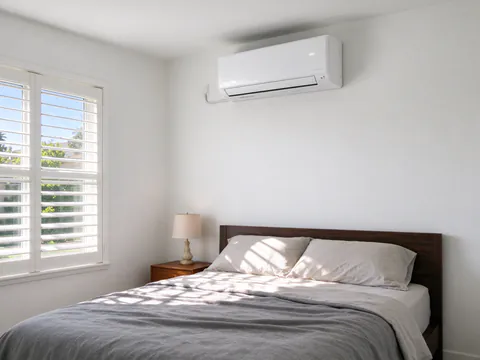
The air carries moisture even on the design day: the CEC lists a 67°F coincident wet bulb at Oceanside’s 78°F design. An inverter unit that runs steadily at low speed removes more of it than an oversized one that cycles, and every head needs a planned condensate route, by gravity through the wall where possible or by pump where not. The indoor unit types guide covers which head styles suit which rooms.
Corrosion risk along Coast Highway
Onshore wind carries salt that attacks the aluminum fins of an outdoor coil. Daikin’s installation manual for one wall-mount line tells installers to avoid spots directly exposed to salt because it may shorten the outdoor unit’s life, and Mitsubishi Electric rates its Blue Fin coil coating at 2,000 hours of ASTM B117 salt-spray testing. A coating slows corrosion rather than stopping it, and no manufacturer document sets a distance from the ocean for these cities, so exposure is judged per lot.
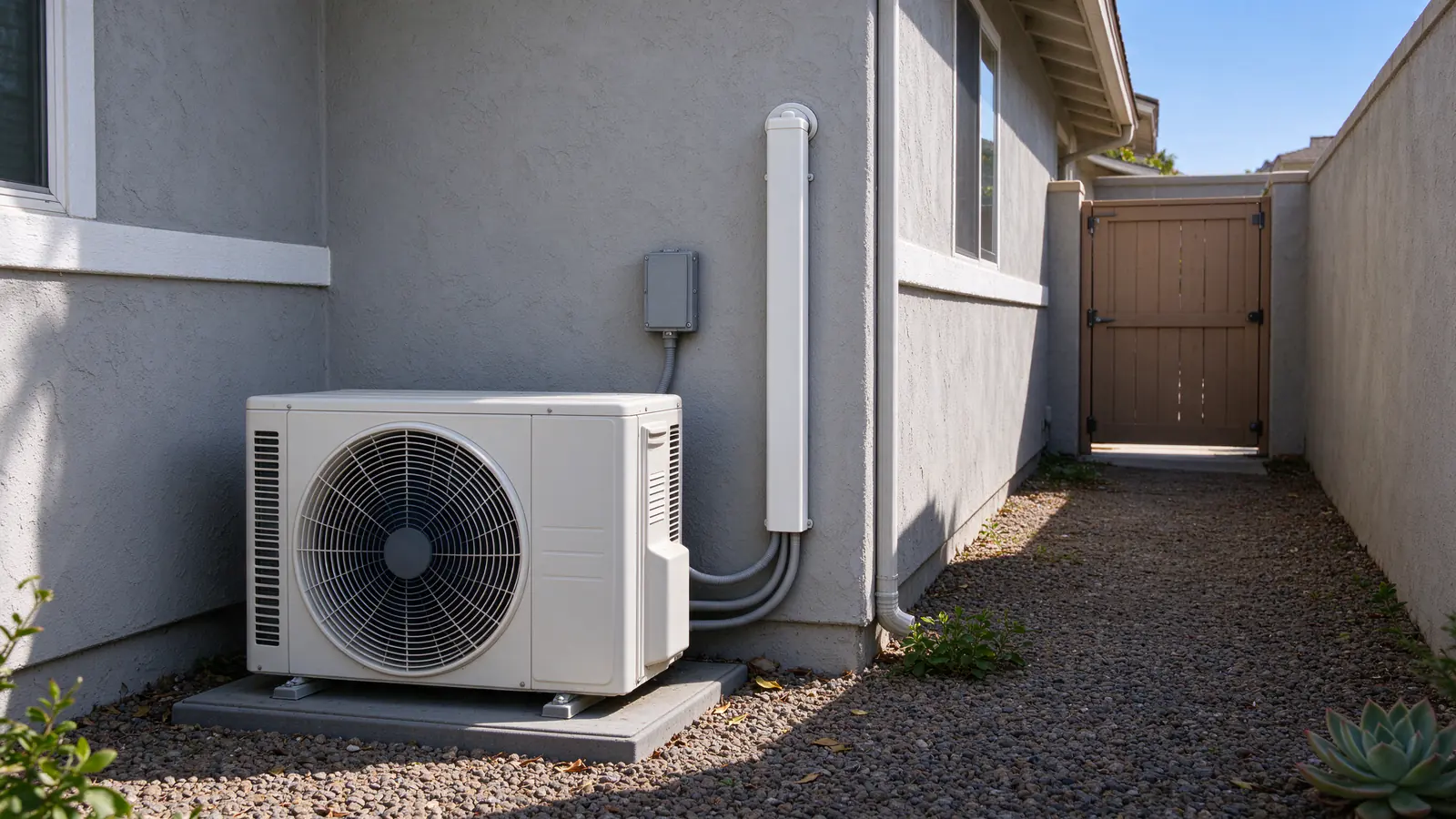
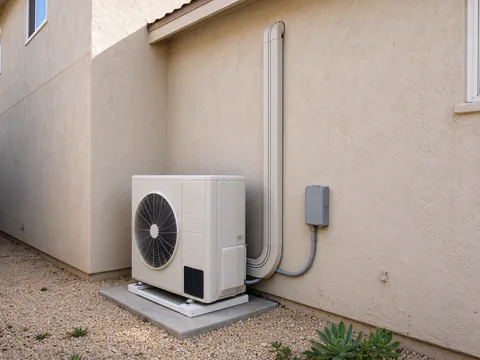
Homes near the beach, around Agua Hedionda Lagoon or along Coast Highway take the most direct wind. Where the lot allows, the outdoor unit goes on the sheltered side of the house, and the quote names the coil protection of the exact model rather than a general coastal claim. Rinsing the coil belongs in mini split maintenance here, and on an older unit, corroded fins turn the visit into a repair or replacement question. The placement guide covers airflow and service clearances.
Oceanside: eTRAKiT and older neighborhoods
The Oceanside Building Division’s permits page lists residential A/C replacement and residential furnace replacement among the single-family permits that contractors apply for through its eTRAKiT system. A new mini split is not listed as its own type, and the page notes that plans may be required and that plan check or permit fees may be collected, without listing amounts. So the path and fee for a new install are confirmed with the City for each address.
Oceanside’s housing is younger than San Diego’s coastal neighborhoods: 37.9% of homes were built before 1980. In older areas such as South Oceanside, Loma Alta and Fire Mountain, and inland toward Mission San Luis Rey along SR-76, ductless retrofits range from a multi-zone system for a whole floor to a single-zone head for the one cold room. Lots in the coastal zone are checked against the City’s coastal rules per address. Whatever Oceanside’s current equipment setbacks are, state law caps them for heat pumps at 3 ft on side and back yards once SB 222 takes effect on January 1, 2027.
Carlsbad: the permit record and HOA questions
Carlsbad issues its own permits. A City of Carlsbad permit record for a ductless installation shows the path: a combined residential plumbing, mechanical and electrical permit, reviewed electronically, and closed with a mechanical final inspection. The City’s permit layer, which stopped updating in January 2024, shows 73 permits mentioning a mini split or ductless system out of 9,886 issued from January 2022. Current fees and requirements are confirmed with the City.
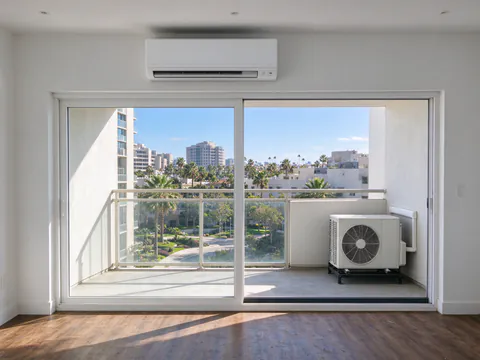
Carlsbad’s housing is newer still, with 29.8% built before 1980. Where a home in Carlsbad Village or La Costa belongs to an association, AB 1684 matters: from January 1, 2027, an HOA may not prohibit or restrict a code-compliant cooling system, heat pumps included, in an owner’s separate interest, charge a fee for it or require a particular contractor. It may still require a licensed contractor and repair of any common-area damage. The condo installation page explains how that works.
Vista, where the climate zone changes
Vista sits inland of both cities and straddles two climate zones: point lookups on the CEC’s map place its center in zone 7 and its eastern side in zone 10. That matters for one rule. The CEC requires refrigerant charge verification on new heat pump systems in every zone, but on cooling-only air conditioners only in zones 2 and 8 through 15, so a cooling-only unit in east Vista gets verified and one in west Vista does not.
The climate shifts with the zone. The CEC lists Vista’s cooling design at 89°F and its heating design at 35 to 37°F, and NOAA counts 18.7 days a year at 90°F or hotter, closer to inland than to coastal conditions. Vista is a separate city with its own building division, and 37.0% of its homes were built before 1980. For a house on the east side, the inland reasoning on the Escondido page, with heating capacity checked at colder design temperatures, fits more closely than the coastal one. The permit guide covers the state rules all three cities apply.