
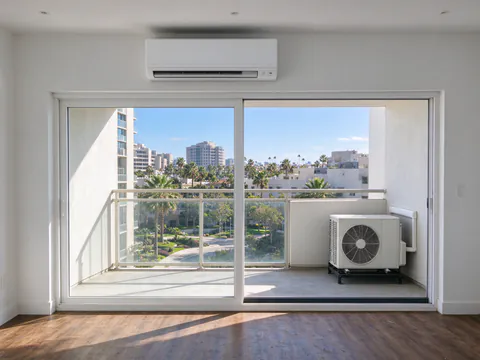
South Park’s historic district covers 407 properties. Put the same mini split installation on a house inside that boundary and on one just outside it, and the City of San Diego handles them as two different permits: a simple no-plan permit for one, drawings and a historical review for the other. In North Park, Golden Hill and parts of Uptown, that boundary check comes before any talk of capacity.
Mesa Mini Split San Diego starts with that check for homes in North Park, Hillcrest, Mission Hills, University Heights, Normal Heights, Kensington, Talmadge, Golden Hill and South Park, all inside the City of San Diego. The installing contractors are licensed and insured, hold the California C-20 (HVAC) license, and pull the permit and coordinate its inspections.
Historic district or not: the permit fork
For a house or duplex with no historic designation, a mini split takes the City’s no-plan combination permit, with a fee starting from $176.57 for the first indoor unit and $52.39 for each added one. A designated property, a potentially designated one, or a house inside a historic district does not qualify: the City requires a standalone permit with mechanical plans and calculations, routed through historical resource review under Information Bulletin 581.
The City Planning Department lists the districts already designated under its North Park and Golden Hill work: Spalding Place (14 properties), Valle Vista Terrace (90) and Melhorn & Son (30) in North Park, and South Park (407) in Golden Hill. Others are in process, including Park Boulevard Residential across Uptown and North Park, Altadena and Kalmia Place in North Park, and Culverwell & Taggart’s in Golden Hill, with 28th Street, St. Louis Heights and Wabash Mesa scheduled after them. Whether a house in a district still in process counts as potentially designated is confirmed with the City before anything is filed. For Mission Hills and Kensington-Talmadge, district status is checked per address rather than assumed.
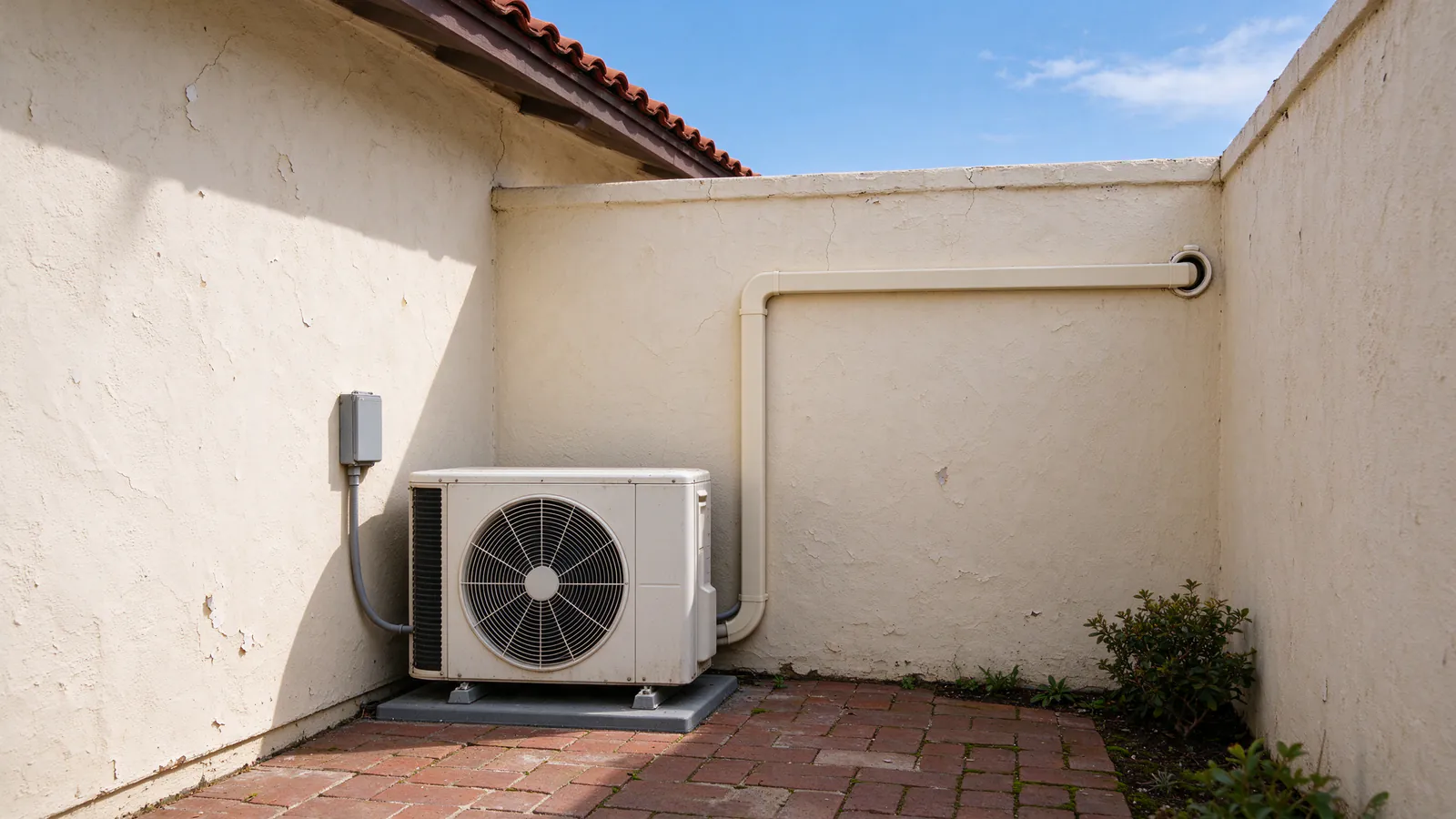
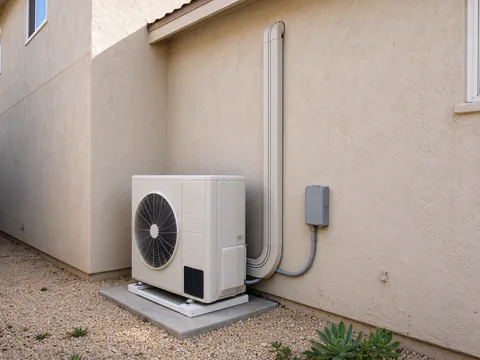
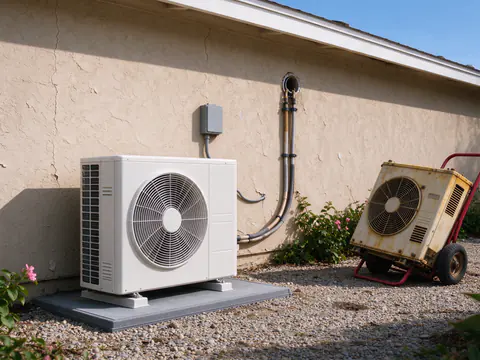
What the review changes in practice is the exterior. The outdoor unit, the line-hide and the wall penetration are the visible parts of a ductless system, so on a historic house they are planned to stay off character-defining facades, which usually means the street side. The condenser goes to a rear or side yard out of view, and the lines leave through a back wall or travel through a closet or attic first. Those routes can lengthen the line set and drain run. The permit guide sets out both paths.
Side yards measured in feet and decibels
Under San Diego Municipal Code section 131.0461, a condenser may encroach into a required side or rear yard if it keeps 4 ft of clearance to the property line. A tighter spot needs sound attenuation built in, with proof that it meets the noise ordinance. Where a side yard is barely wider than the unit, that clause decides both the spot and how quiet the model must be.
The limits are measured at the property line as one-hour averages. Single-family zones allow 50 dB from 7 a.m. to 7 p.m., 45 dB until 10 p.m. and 40 dB overnight. Lower-density multifamily zones allow 55, 50 and 45 dB. The overnight figure is the one a heat pump running on a cold night has to meet, so the outdoor unit’s rated sound level, its distance from the line and any barrier all go into the decision. The noise guide explains how those ratings compare.
SB 222 changes the arithmetic from January 1, 2027: for a residential heat pump system, cities can then demand at most 3 ft of setback at the side and back of a lot and 10 ft at the front, and a mini split with a heating mode counts as a heat pump. The City has not yet published how it will apply that alongside its 4 ft rule, so a 3 ft placement is confirmed before the design depends on it. The placement guide covers airflow and service clearances.
Wall heaters, electric heat and no heat at all
Mid-City homes run on electric heat far more than the city as a whole. Census figures put electricity as the heating fuel in 51.5% of homes in ZIP 92103 (Hillcrest and Mission Hills) and 44.0% in 92104 (North Park), against 39.0% citywide, and 9.8% of 92104 households report using no heating fuel at all.
The housing is old enough to explain it. In 92104, 26.0% of homes were built before 1950; in 92116, which takes in Normal Heights and Kensington, 29.7%; and in 92102, around Golden Hill and South Park, 34.8%. Where a house of that age has no ductwork and relies on wall or baseboard heaters, a heat pump mini split can take over heating as well as cooling. A heat pump moves heat rather than making it from resistance, so it uses much less electricity for the same warmth, and a home with one can choose SDG&E’s TOU-ELEC rate. Housing age is context, not a diagnosis of any one house.
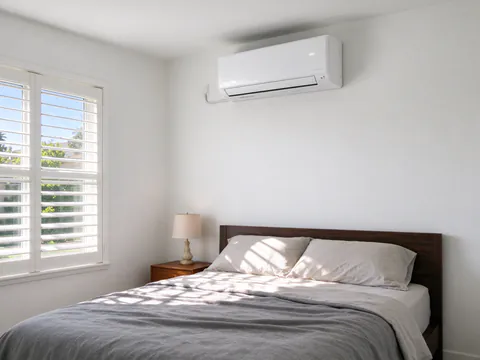
The number of heads follows the rooms, not the floor area. A bungalow with an open living and dining room may be well served by one head there, while bedrooms kept closed at night each need their own. A Manual J load calculation decides, as the sizing guide explains, and the single-zone vs multi-zone guide explains where one outdoor unit serving several heads makes sense. Every head also needs a condensate drain: a steady fall to the outside where the wall allows it, or a small pump where it does not. The guide to adding cooling without ducts covers the alternatives.
North Park, South Park and Golden Hill
North Park recorded 42 approvals mentioning mini splits in City of San Diego permit data from October 2025 to September 2026, 24% of its HVAC approvals and the highest count of any area on this page. Three of the four designated districts sit here, around the blocks north of Balboa Park and off University Avenue and 30th Street, and Altadena, with roughly 400 properties, is in process. Golden Hill added 8 approvals, and the South Park district is its largest designation. In this part of Mid-City the historic check comes before anything else. Where several rooms need conditioning, multi-zone systems keep to one outdoor unit and one exterior route.
Hillcrest, Mission Hills and University Heights
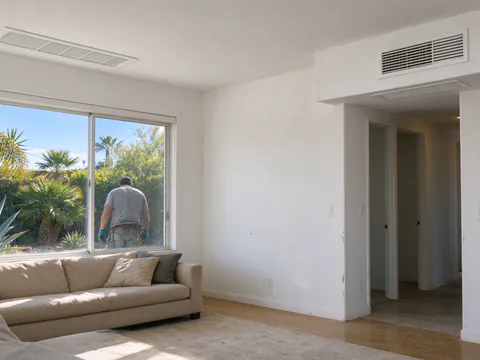
Uptown, the City’s planning area for Hillcrest, Mission Hills and University Heights, recorded 35 mini split approvals, 16% of its HVAC work. The Park Boulevard Residential district, in process, straddles Uptown and North Park along Park Boulevard. Where a Hillcrest home is a condo or a flat in a small building with an association, AB 1684 changes the approval question: from January 1, 2027, it stops an HOA from prohibiting a code-compliant cooling system in an owner’s unit, as the condo installation page explains. In period rooms where an owner wants no wall head, a concealed-duct unit in an attic or closet can serve the space through short ducts.
Normal Heights and Kensington-Talmadge
Normal Heights had the highest mini split share on this page: 15 of its 56 HVAC approvals, 27%, against about 10% citywide. Kensington-Talmadge followed with 19 approvals, 22%. These neighborhoods off Adams Avenue and El Cajon Boulevard sit farther inland and remain in Title 24 climate zone 7 on the CEC’s climate zone map, but NOAA normals show how inland heat builds: Montgomery Field on Kearny Mesa averages 16 days a year at 90°F or above, against 3 at Lindbergh Field. A west-facing upstairs room here can need more cooling than the same room near the coast.
What to have ready for the first visit
Start with the street address, since the historic lookup and the zone of the lot both hang on it. Then list the rooms that are uncomfortable, what heats the house now, the panel’s rating and any association rules. On site, each room is measured for its own load, the side-yard widths are taped against the 4 ft and decibel limits, and the route for lines, drain and power is marked out. Once the equipment is in, the lines are pressure tested with nitrogen, pulled down to a deep vacuum read on a micron gauge, charged to the manufacturer’s figure and run in both modes before the walkthrough. For a number before anyone visits, try the cost estimator.