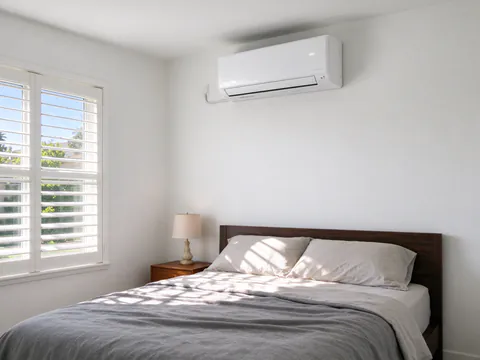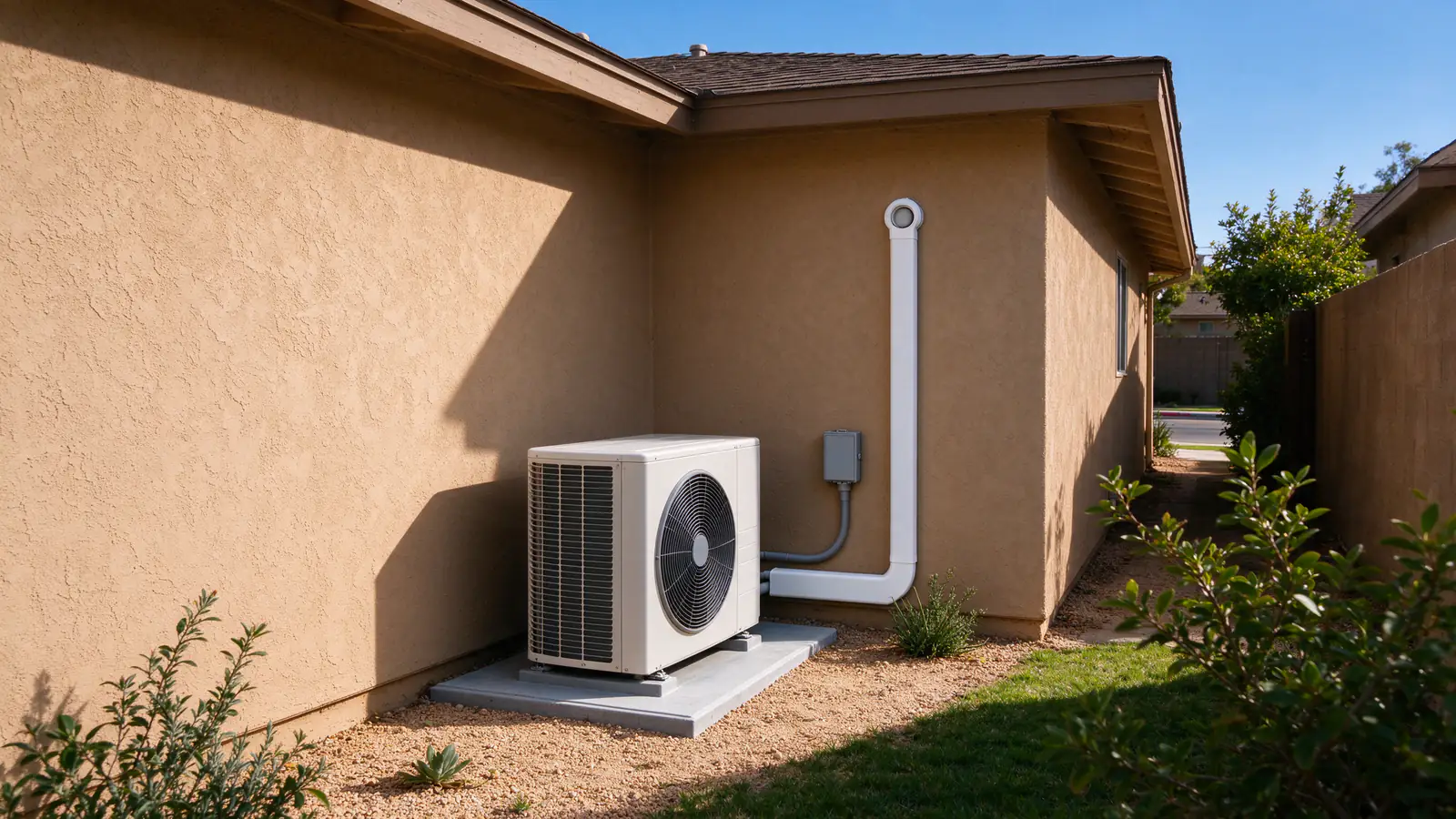
A single-zone mini split installation (one indoor head and one outdoor unit) typically costs about $3,000 to $7,500 installed in the San Diego area; two or three heads run about $7,000 to $16,000, and whole-home systems with four or more heads start around $13,000 and commonly pass $18,000. These are budgeting ranges, not quotes.
Mesa Mini Split San Diego installs single-zone and multi-zone mini splits across San Diego County, with the work done by licensed and insured contractors holding the California C-20 (HVAC) license. This guide takes a San Diego price apart: what each range covers, why two similar houses get different numbers, which parts have a public figure from an agency and which are scope to check on site. If a number is what you need first, the mini split cost estimator gives one without a phone call.
Typical San Diego mini split installation price ranges
Price follows the number of indoor heads first, because each head brings its own line set, wall penetration, condensate route and commissioning, and because the outdoor unit grows with the number of rooms it serves. The ranges below are typical San Diego-area figures for installed systems.
| System | Typical San Diego-area range | What the range covers |
|---|---|---|
| Single-zone: one indoor head, one outdoor unit | About $3,000 to $7,500 | Equipment, line set, wall penetration, condensate drain, electrical hookup and commissioning for one room. Line-set length, a new 240V circuit, head style and capacity move a job within the range |
| Two or three indoor heads on a multi-zone system | About $7,000 to $16,000 | A multi-zone outdoor unit or separate single-zones serving several rooms; two-head systems sit toward the lower part |
| Four or more heads, whole house | From about $13,000, commonly past $18,000 | Large multi-zone or several outdoor units; large premium-brand systems can exceed $30,000, so the top is left open |
| 100A to 200A service and panel upgrade, where needed | About $2,800 to $5,500 | Panel and service upgrade including permit and coordination of SDG&E’s disconnect and reconnect; panel relocation, underground service or trenching costs more |
The panel line is not part of every job. Many San Diego houses carry a panel with room for one more 240V circuit, and some need a load calculation before anyone knows. Treat it as a separate line that appears only where the electrical review says so. The electrical requirements guide explains how circuits, disconnects and panel capacity are checked.
Single-zone vs multi-zone cost
One multi-zone outdoor unit serving two rooms usually costs less than two complete single-zone systems, because the rooms share one compressor, one pad and one electrical circuit. The trade-off is that a multi-zone unit sized for several rooms can run inefficiently when only one small room calls for cooling, and a failure takes every room down at once. Two single-zones cost more up front but keep each room independent. Which layout fits depends on how the rooms are used, not on price alone; the single-zone vs multi-zone guide walks through that choice, and the multi-zone installation page covers whole-house layouts.
Why there is no honest per-head price
Dividing a range by the number of heads produces a figure that describes no real job. The first head carries the outdoor unit, the circuit, the disconnect and the setup; each added head carries its own line set, penetration and drain but shares the rest. The City’s own permit schedule follows the same logic: $176.57 for the first mini-split unit and $52.39 for each additional one. A ceiling cassette head with a condensate pump costs more to add than a wall head on an exterior wall, so a per-head number would mislead in both directions.
What moves a San Diego mini split price
| Driver | Why it moves the price | Typical effect |
|---|---|---|
| Line-set length and route | Longer runs need more copper, insulation, fittings and sometimes extra refrigerant, and a route through an attic or around a second story takes more labor; outdoor unit placement sets the length | A short run straight through an exterior wall to a side-yard pad sits low in the range; long or multi-story runs push it up |
| Indoor head style | Wall heads mount on a bracket; ceiling cassettes need framing work and usually a pump; concealed duct units need an attic or soffit space and short ducts | Cassette and concealed duct heads carry a premium over wall heads |
| Capacity and location | Inland design days run near 90°F at El Cajon against 82°F at the coast (CEC), so the same room can need more capacity inland | Larger capacity raises equipment cost; correct sizing comes from a load calculation, never square footage alone |
| Electrical | Every system needs a dedicated circuit and a disconnect; a full panel may need a subpanel, a load study or a service upgrade | From a routine circuit to a separate panel-upgrade line |
| Condensate path | Gravity drains to the outside are simple; interior walls, cassettes and below-grade rooms need a pump | A pump and its wiring add parts and a maintenance item |
| Outdoor unit mounting | A pad at grade is simplest; wall brackets and roof stands need structural attention, and some mountings trigger plans under the City’s rules | Brackets, stands and anything that needs plans push the price up |
| Line-hide and stucco | Painted line-hide covers protect the lines and look tidier; every penetration through stucco has to be sealed and patched | Longer runs with more elbows cost more; paint-matched finishes cost more than standard covers |
| Historic or coastal review | Designated historic properties need plans and historical review in the City, as in parts of North Park and Uptown; bluff-edge and some beach lots lose the coastal permit exemption | Adds design, permitting time and placement limits |
| New install vs replacement | A replacement may reuse a line set only when size, length, condition and refrigerant type suit the new unit | Reuse can save material; replacing the line set is common when equipment changes |
| Equipment tier | Inverter performance at low outdoor temperatures, quiet ratings and anticorrosion coil coatings vary by model; see coastal vs inland equipment | Premium lines and coated coils cost more |
None of these drivers comes with a fixed multiplier. Two quotes for the same room can differ widely because one assumes a straight 10-foot run and a gravity drain while the other prices a second-story route and a pump. Read the scope before the total.
What’s inside a San Diego mini split price
| Part of the price | What sets it | Local public figure |
|---|---|---|
| HVAC installation labor | Number of heads, line-set routes, mounting, commissioning | HVAC mechanics and installers in the San Diego-Chula Vista-Carlsbad metro earn a mean $36.52 an hour against $31.14 nationally, and a median $36.00 against $29.33 (U.S. Bureau of Labor Statistics, OEWS). A wage, not a billing rate |
| City of San Diego permit | Number of indoor units, any added circuits or panel work | From $176.57 for the first mini-split unit, $52.39 each additional; the exact total is set when the permit is issued (City of San Diego Development Services) |
| County permit, unincorporated areas | Mechanical only, or mechanical plus electrical | $392 mechanical only, $498 mechanical and electrical (County of San Diego Planning & Development Services) |
| Title 24 field verification | Refrigerant charge verification by a HERS or ECC rater where the compliance form calls for it | No public fee: scope to check |
| Electrical circuit and panel | Panel space, load, distance to the outdoor unit | Electricians in the metro earn a mean $39.54 an hour against $34.37 nationally (BLS). City permit for up to five new 15-45 amp circuits: $176.57; panel replacement or upgrade up to 200 amps: $176.57 |
| Equipment | Brand, capacity, number of zones, head style, coil coatings | No public figure |
| Wall penetration, stucco patching and line-hide | Number of penetrations, run length, finish | No public figure: scope to check |
HVAC mechanics in the San Diego metro earn a mean wage about 17% above the national mean, and the median gap is about 23%, which is one documented reason local installation prices sit above national averages. A wage is not a billing rate: the rate a contractor bills also carries insurance, licensing, vehicles and overhead, along with permits, tools and supervision. Multiplying a wage by a guessed number of hours does not produce a project price, because the hours depend on routes, mounting and access that only a site visit establishes.
Title 24 verification
California’s Energy Code treats a new mini split as an alteration that needs a permit and a load calculation. The California Energy Commission’s HVAC guidance calls for prescriptive refrigerant charge verification on new heat pumps in every climate zone, and on cooling-only air conditioners in zones 2 and 8 through 15. Coastal San Diego sits mostly in climate zone 7 and inland valleys such as El Cajon and Escondido in zone 10 on the CEC’s climate zone map, so a cooling-only unit can carry a different verification scope on each side of town; a heat pump mini split carries it everywhere. The required verifications are listed on the project’s compliance form, and a rater’s fee has no public figure. The permits guide covers the paperwork in more detail.
Permit fees for a mini split in San Diego
| Jurisdiction and item | Published fee |
|---|---|
| City of San Diego: Air Handler, Mini-Split, first unit | $176.57 |
| City of San Diego: each additional mini-split unit | $52.39 |
| City of San Diego: Condensing Unit for HVAC, each | $131.52 (whether it is charged alongside the mini-split item is set at issuance) |
| City of San Diego: new circuits 15-45 amps, first five | $176.57 |
| City of San Diego: panel replace or upgrade up to 200 amps | $176.57 |
| City of San Diego: mapping fee, only when plans are used | $12.16 |
| County of San Diego (unincorporated): mechanical only | $392 |
| County of San Diego (unincorporated): electrical and mechanical | $498 |
City figures come from Development Services Information Bulletin 103; County figures from the Planning & Development Services fee schedule. A mini split at a house or duplex in the City is normally a no-plan combination permit, but historic designated or potentially historic properties need plans and historical review. Cities such as Chula Vista, Carlsbad, Oceanside and Escondido set their own fees and processes.
State law is about to change the ceiling. SB 222 caps the permit fee for a residential heat pump HVAC system at $200 from January 1, 2027, unless a city or county adopts written findings that its reasonable cost is higher. How the City of San Diego will apply the cap has not yet been published, so confirm the fee when the permit is pulled.
Rebates and incentives for San Diego mini splits
Most of the large heat pump programs that San Diego homeowners read about online have ended or filled. What remains is mostly income-qualified or a rate option. Never budget on a rebate until the program confirms it for your address and household; the rebates guide tracks the details.
| Program | Administrator | Status | Who qualifies |
|---|---|---|---|
| Federal Energy Efficient Home Improvement Credit (25C) | IRS | Ended for property placed in service after December 31, 2025 | No longer available for new installations |
| HEEHRA single-family heat pump rebates | California Energy Commission, through TECH Clean California | Closed; the waitlist closed July 17, 2026, and a later phase has not been announced | Income-verified households, when open |
| TECH Clean California single-family heat pump incentives | TECH Clean California | Closed, fully reserved statewide | n/a |
| California Energy-Smart Homes whole-building electrification | Statewide program for SDG&E electric territory | Current year’s funding fully subscribed | Whole-house electrification only; a single-room mini split does not qualify |
| City of San Diego HEART | City of San Diego | Closed to new applications | n/a |
| SDG&E, San Diego Community Power, Clean Energy Alliance | Utility and community power providers | No heat pump HVAC rebate listed | n/a |
| Equitable Building Decarbonization direct install | California Energy Commission, regional administrator; promoted by San Diego Community Power and Clean Energy Alliance | Open while state funding lasts | Households at or below 80% of area median income in identified communities; the program assigns its own installer. Check eligibility with the administrator |
| SDREN Home Energy Savings | San Diego Regional Energy Network | Open, by interest list | Detached single-family homes, duplexes and manufactured homes in the county built before 2020; some households qualify for no-cost upgrades. Check eligibility with the administrator |
| SDG&E financing | SDG&E | Listed: GoGreen Financing and On-Bill Financing | Subject to SDG&E’s terms |
| SDG&E TOU-ELEC rate | SDG&E | Available | Homes with an electric heat pump for climate control, an EV or battery storage |
Both income-qualified programs are run by their administrators, who decide eligibility and arrange the work, so they are not a discount that can be applied to a private installation. Check eligibility directly with each administrator. Program status changes, which is why nothing here is presented as current or guaranteed.
Illustrative San Diego budgets
These examples are illustrative. They show how the ranges above combine; they are not quotes and do not describe real jobs.
Illustrative: a coastal bedroom, single-zone. An upstairs bedroom in a Point Loma or Ocean Beach house, a wall head on an exterior wall, a short line set down the side of the house to a pad in the side yard, and a panel with room for one more circuit. This is the simple end of the work, so the planning figure sits in the lower part of the $3,000 to $7,500 single-zone range, plus the City permit from $176.57 if the proposal lists it separately. A longer run, a line-hide up two stories or a pump for an interior drain would move it up. Coastal salt air is a reason to ask about coil coatings, which is an equipment choice rather than a fixed add-on.
Illustrative: a three-head inland ranch. A single-story ranch in El Cajon with no ducts, three heads for the living room and two bedrooms, one multi-zone outdoor unit, and a 100-amp panel that needs a service upgrade. The system plans inside the $7,000 to $16,000 two-to-three-head range, and the upgrade adds $2,800 to $5,500, for a planning envelope of roughly $9,800 to $21,500. If the panel has room, the upgrade line drops away. El Cajon’s 90°F design day is why the load calculation matters more here than at the coast.
Illustrative: a whole house with four or more heads. Four heads or more start at about $13,000 and commonly pass $18,000; large premium-brand systems can exceed $30,000. The range stays open at the top because head styles, the number of outdoor units and the electrical work vary too much for a ceiling.
Setting the illustrative budgets side by side with the El Cajon and coastal San Diego pages shows how climate changes the sizing decisions behind each.
Running cost on SDG&E rates
Installation is one cost; electricity is the one that repeats. SDG&E’s TOU-ELEC rate is open to homes with an electric heat pump for climate control, and a mini split is a heat pump. On its published rates, which change from season to season, summer on-peak power (4 to 9 p.m.) costs about 73 cents per kWh against about 34 to 39 cents off-peak and super off-peak; winter on-peak runs about 51 cents. Cooling a room earlier in the afternoon, before the on-peak window, shifts usage to cheaper hours.
Heating is a different story from cooling. Against an 80% gas furnace, an estimate from SDG&E’s published rates puts the break-even efficiency for a heat pump near a coefficient of performance of 3.3 at TOU-ELEC winter off-peak prices, so a mini split replacing gas heat may not lower the heating bill. Replacing electric resistance wall or baseboard heat is where heating savings are more likely, because a heat pump moves several units of heat for each unit of electricity. No savings are guaranteed either way; the operating cost guide works through the arithmetic.
Repair and maintenance costs
Repair and maintenance are separate services with their own pricing. A diagnostic or service-call fee for San Diego-area HVAC repairs, mini splits included, typically runs about $75 to $150 for a standard daytime visit and up to about $250 after hours. The repair itself depends on what the diagnosis finds. See mini split repair for common faults and mini split maintenance for what a cleaning covers.
Getting a San Diego price you can compare
A useful quote names the number of heads and their style, the capacity of each and the load calculation behind it, the line-set routes, the condensate path for each head, the electrical work, the outdoor unit’s mounting and location, the permits and any field verification, and what happens to the stucco. Two quotes that list all of that can be compared line by line; a single total cannot.
The next step is a site visit where rooms are measured and a Manual J load calculation sets the size, followed by a written, itemized scope. Start with the cost estimator for a planning figure, read the single-zone installation page if one room is the problem, or call to book the visit.